A lead engine that finds businesses the web forgot
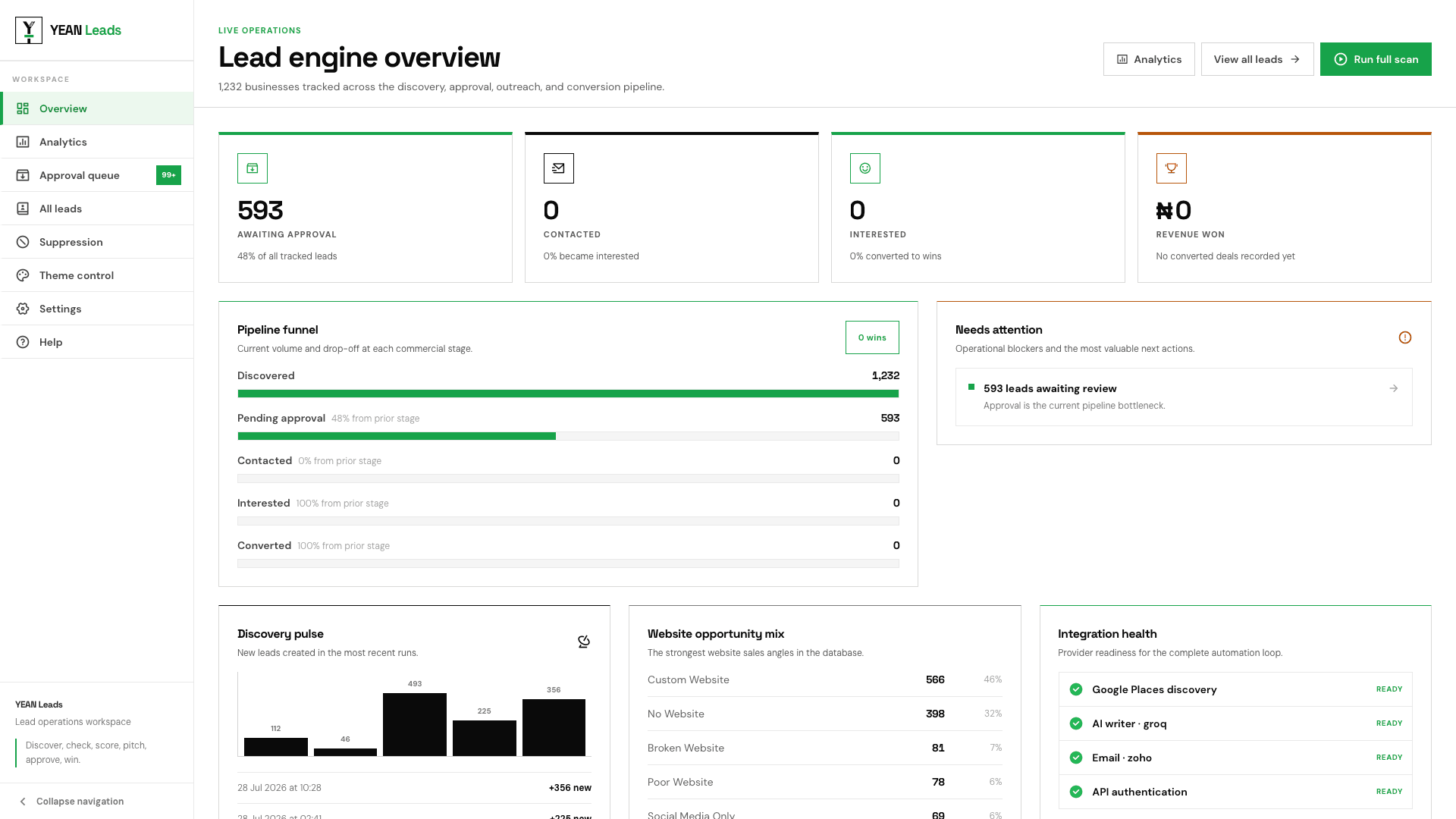
Our own new-business pipeline. It finds businesses, checks whether their website actually works, scores how badly they need one, drafts a pitch, and holds everything for a human to approve before anything is sent.
- Web applications
- Product design
- Automation
- Next.js
- Node.js
- TypeScript
- MongoDB
- Express
- Railway
By the numbers
Why we built it
Plenty of businesses are running on a Linktree, a Facebook page, or a site that stopped loading two years ago and nobody noticed. They are not hard to help. They are hard to find, one at a time, by hand.
So we built the finding part. What we would not build was anything that blasts strangers automatically, because that is spam and it burns the name we are trying to make.
How it works
Three sources feed one deduplicated pipeline: business listings, a directory and sitemap crawler, and manual imports. Each business then goes through a website check covering DNS, certificates, HTTP status, redirect loops, response time, mobile viewport, page titles, dead links and the signatures of hosted storefronts or link-in-bio pages.
That produces a classification rather than a guess: no website, broken website, social-only, link-in-bio only, or a real site that simply performs badly. Contact details are gathered only from the business's own public pages, and every value records where it came from.
A score decides what reaches us. Anything above the threshold gets a short drafted pitch written from that specific business's situation, and lands in an approval queue.
The part that matters
Nothing leaves the system without a person clicking approve. There is one follow-up, only if there was no reply, and a hard daily cap. Every action is logged.
The whole interface is data too: colour, corners, type, spacing, motion and the order of the navigation all live in one theme document, editable from a control page. That system is the one now running this website.